
When people first hear "Bitcoin heating," many think: "sounds nice, but isn't this some kind of crypto scheme?"
That reaction is understandable. Bitcoin has picked up so much hype over the years that just hearing the word makes people roll their eyes. But Bitcoin heating is technically far simpler than it sounds — and you don't need to care about investing to understand it.
Why does every electrical device produce heat?
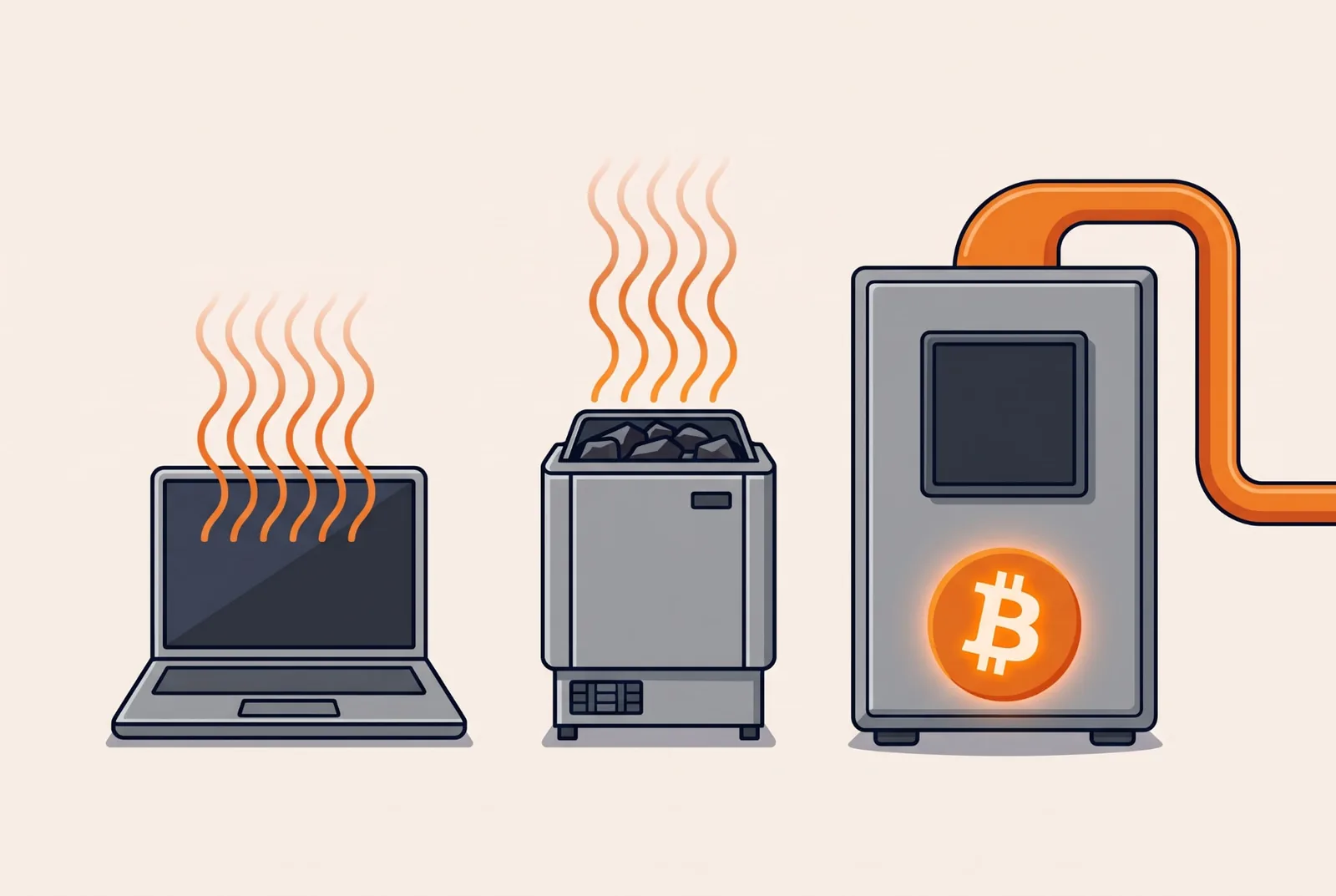
Every electrical device heats up. That's not a flaw — it's physics. Under the first law of thermodynamics, energy is never lost, only converted. In computing, this means the electrical energy a device consumes is, in practice, converted almost entirely into heat. Computation doesn't store energy or do mechanical work, so all the electricity going in comes back out as heat.
Most of the time, that heat is unwanted waste energy. A laptop trying to run a spreadsheet isn't trying to heat a room, so the heat gets blown out by fans. That cooling itself uses even more electricity, just to keep the device from overheating.
In a large data center, cooling is often the single biggest cost — that is, how efficiently the waste heat can be removed from the building.
A Bitcoin miner works on exactly the same principle, with one difference: the waste heat from the computation is precisely what's meant to be produced. Putting waste heat to use — that's the whole idea.
Why does Bitcoin mining produce heat?
The Bitcoin network needs computers that continuously solve computational problems to function. These computers keep the network running and verify transactions. In return for that work, they earn a Bitcoin reward.
Mining uses electricity. All of that electricity becomes heat — exactly as it would in an electric sauna heater or boiler. The difference is that mining also generates Bitcoin revenue at the same time.
This is the whole idea: you're going to buy the electricity for heating anyway, but by running it through mining hardware first, you get both the heat and the Bitcoin income in return. Free heat doesn't exist, but the Bitcoin revenue generated as a by-product of that heat can cover your electricity bill — or exceed it.
How does Bitcoin heating work in practice?
SunBit's Bitcoin Boiler works like any heating boiler. It connects to the home's water-based heating system — the same radiators or underfloor heating that have always heated the house. Mining hardware runs inside it, but residents never notice it in daily life.
One mining unit is rated at 5.3 kW. Each Bitcoin Boiler holds two units, giving a heating output of 10.6 kW per boiler. If a property needs more capacity, several boilers can be installed in parallel. This way the system is sized to match the property's actual heating demand.
All the electricity consumed is converted fully into heat, which is transferred into the property's water circuit. Water temperature reaches up to 60°C — enough for both radiator-based systems and underfloor heating.
In summer, when electricity is cheap, the mining hardware can run around the clock even without any heating demand. SunBit's service includes remote management and spot-price optimization, which automatically runs the unit whenever mining revenue exceeds the electricity price. Any excess heat the home doesn't need is rejected through an outdoor unit.
What does Bitcoin heating mean for your electricity bill?
Here's a concrete example. An all-electric detached house with a heating demand of 20,000 kWh per year, and an all-in electricity price of €0.11/kWh including grid fees and taxes.
| Item | Calculation | Annual amount |
|---|---|---|
| Electricity for heating | 20,000 kWh × €0.11/kWh | €2,200 |
| Mining revenue | 20,000 kWh × €0.13/kWh | €2,600 |
| Net effect | +€400 in the customer's favor |
Mining revenue is based on the Antminer S21 XP Hyd and September 2026 market conditions.
The net effect is positive. Note that the electricity price used here is the all-in rate, not the average spot-market price. This is covered in more detail in our article on where heating costs actually come from.
Is this guaranteed? No. Bitcoin revenue moves with the exchange rate and mining difficulty. Figures can be better or worse depending on market conditions. That's why SunBit's calculator runs the numbers for your specific property — including under more conservative assumptions.
The key difference from other systems is this: a traditional heating system is always a cost. Bitcoin Boiler is a system where the relationship between cost and revenue can look entirely different.
Who is Bitcoin Boiler suitable for — and who isn't it for?
Bitcoin Boiler requires a water-based heating system: radiators or underfloor heating. It's a particularly good fit for replacing or supplementing oil heating, and for any property that already has a working hydronic system. It isn't suitable as-is for a home with only direct electric heating.
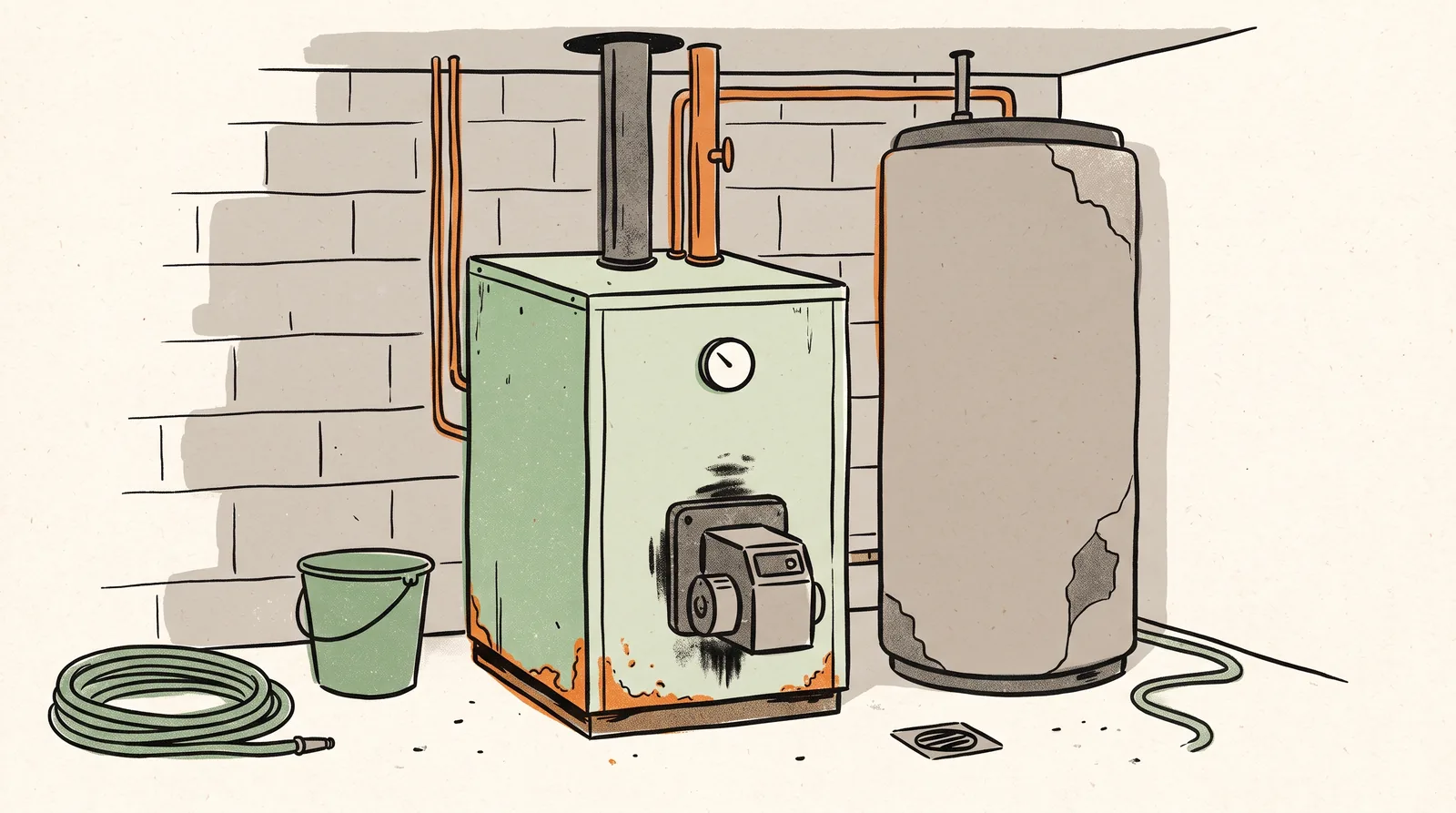
Homes currently on oil heating are in an especially good position here, since the water circuit already exists and doesn't need to be built. The full set of alternatives and their costs are covered in Replacing Oil Heating — What Your Options Actually Are.
Bitcoin Boiler is the best fit for a homeowner who is considering replacing their heating system, wants to lower heating costs over the long term, and understands this is an investment — not a monthly gamble.
The same principle scales to larger properties, just at a different scale. In 2027, SunBit is bringing a system designed for commercial buildings to market, with output of up to 100 kW. Advance enquiries can be sent directly to Elmeri Suomi at elmeri.suomi@sunbit.fi or +358 44 329 4406.
Noise, safety and space requirements
Three questions come up almost every time.
Noise. A traditional air-cooled mining rig is loud — it's essentially a row of powerful fans. Bitcoin Boiler is built around liquid-cooled miners, where heat is transferred into a liquid instead of being blown into the air, so far fewer fans are needed. It isn't completely silent — there's a faint hum — but it's installed in a utility room or basement, in the same spot where an oil boiler or ventilation unit would previously have been, so it shouldn't cause any practical disturbance.
Safety. This is an electrical appliance installed to standard electrical code and connected to the home's existing heating system. The risk profile is the same class as an electric boiler, a sauna heater, or a hot water tank — all of them convert large amounts of electricity into heat. What matters is installation quality, not the fact that the device also happens to compute something.
Space and electrical connection. The unit is installed in a utility room or basement, the same place an oil boiler or hot water tank would go. It's neither seen nor heard from living spaces. Before installation, we also check whether the property's electrical connection needs upgrading — this depends on the number of units installed and the property's current connection size, and is a separate cost. This is assessed during the site survey, before any quote is given.
Do I need to manage Bitcoin heating myself?
No, not in practice. Mining, remote management, and equipment monitoring are all handled by SunBit. Installation is turnkey. What the resident sees is a warm home and, potentially, Bitcoin revenue — everything else happens behind the scenes.
In short
Bitcoin heating isn't investing or speculation. It's a heating system where mining hardware produces heat, and Bitcoin income as a by-product covers electricity costs.
The mechanism is simple: electricity powers the mining, mining produces heat and Bitcoin, the heat warms the home. The complexity comes from the markets, where the expected return fluctuates.
If you want to see what the numbers look like for your own home, the calculator is here.
Next: Replacing Oil Heating — What Your Options Actually Are and What They Cost.