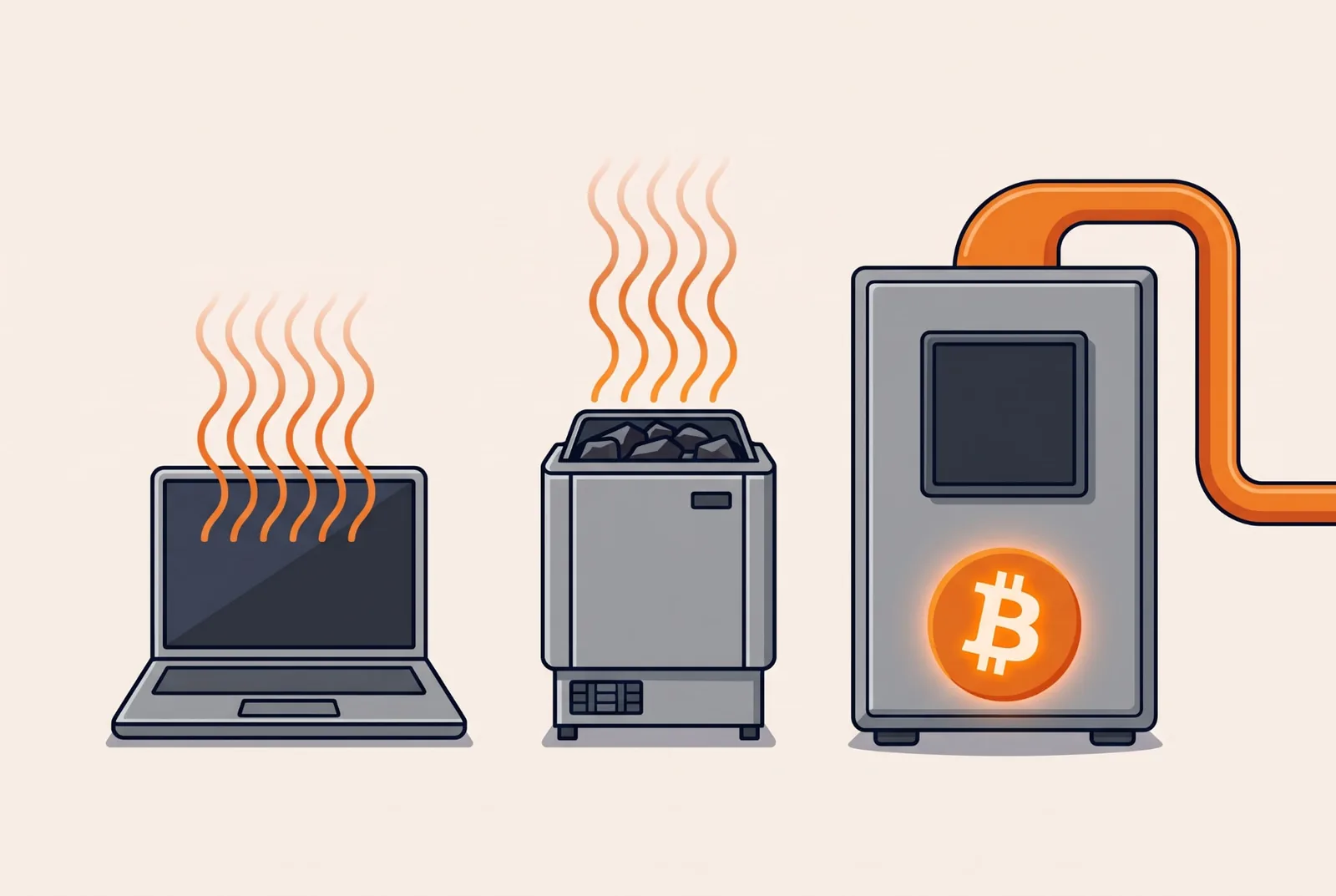


Most people know roughly what heating costs them per year. Fewer know what makes up that number — and fewer still know which part of it they can actually influence.
That's unfortunate, because any decision about a heating system rests on exactly that understanding. Without it, comparing sales pitches from different companies is close to impossible.
Let's break the bill down.
How much does heating a house actually cost per year?
The table below shows the typical annual heating cost for a detached house across different systems, at a heating demand of 20,000 kWh per year.
| Heating system | Energy purchased per year | Annual cost |
|---|---|---|
| Oil heating | ≈ 2,350 litres of oil | ≈ €3,300 |
| District heating | 20 MWh of heat | ≈ €2,400 |
| Direct electric or electric boiler | 20,000 kWh electricity | ≈ €2,200 |
| Air-to-water heat pump | ≈ 7,100 kWh electricity | ≈ €790 |
| Geothermal | ≈ 5,700 kWh electricity | ≈ €630 |
| Bitcoin Boiler | 20,000 kWh electricity | ≈ −€400 (generates income) |
Assumptions behind the table
Heating demand 20,000 kWh/year · all-in electricity price €0.11/kWh including grid fees and taxes · heating oil at €1.40/litre and 85% boiler efficiency · district heating at €90/MWh plus a €50/month standing charge · air-to-water heat pump SCOP 2.8 · geothermal SCOP 3.5 · mining revenue €0.13/kWh.
District heating prices vary significantly by location, and electricity prices by contract and grid area — the ranking above could be different for your own property. Bitcoin Boiler is the only figure in the table with market risk attached. Heat pump figures are based on a full-season average; efficiency drops noticeably during cold snaps.
Mining revenue is based on the Antminer S21 XP Hyd and September 2026 market conditions.
The table is indicative, and every figure results from three variables. If even one of them differs for your property, the whole ranking can shift.
Three factors
Heating cost is the product of three things: how much heat the house needs, how efficiently the system produces it, and what the energy costs.
The heating bill formula
heat demand ÷ efficiency × energy price = bill
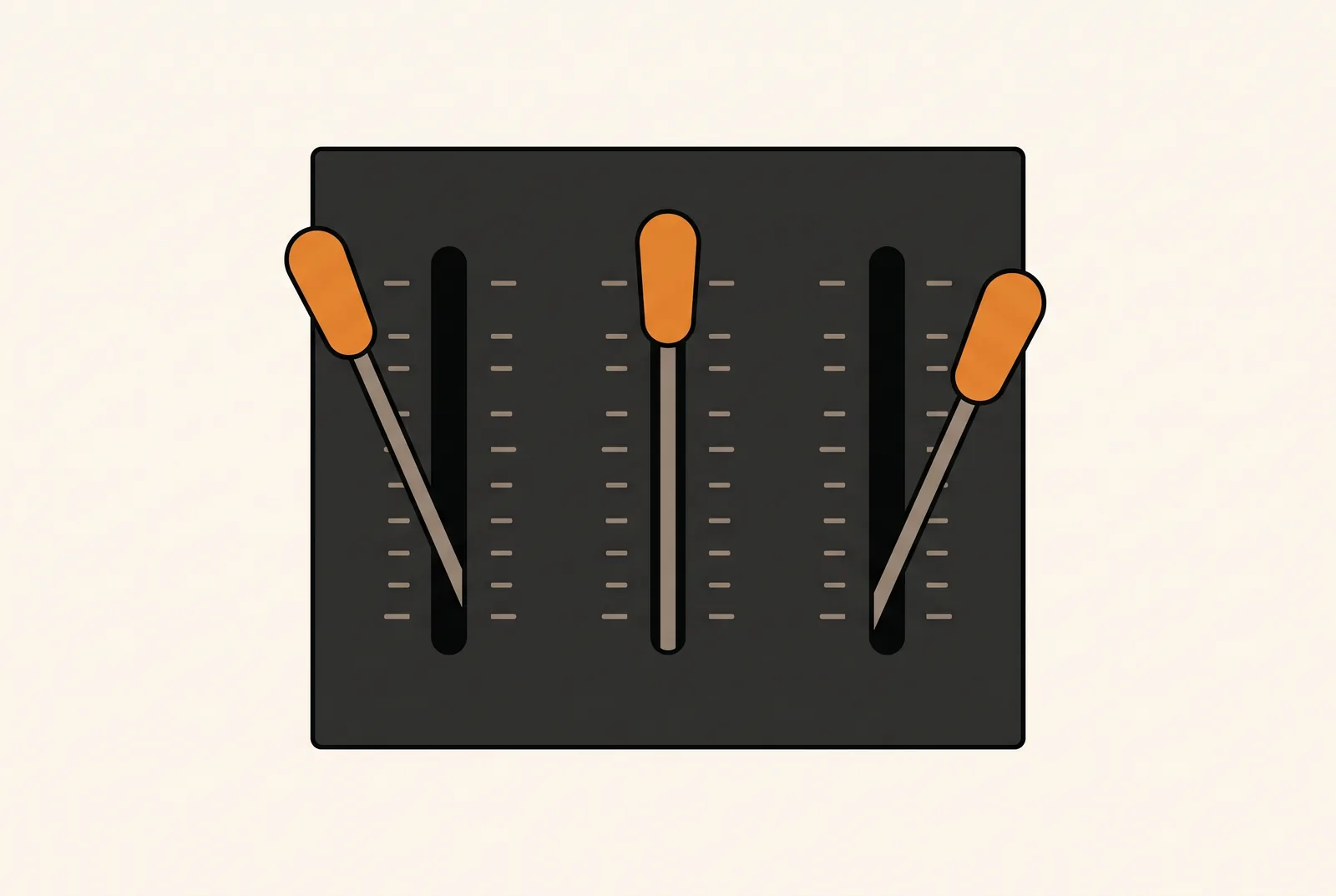
Each of the three factors is its own lever, and they can be pulled in different directions. The same house can cost very different amounts to heat depending on which lever moves.
Lever 1: Heat demand
Heat demand is the amount of energy a house needs to stay warm. In a Finnish detached house it's typically 15,000–30,000 kWh per year, but that range is wide.
It depends on floor area, year built, insulation, window condition, ventilation type, and how warm you want to keep the home. Location matters too: a house in Rovaniemi needs significantly more heating than one in Turku.
Changing this lever means renovation — extra insulation, new windows, heat-recovery ventilation. These are effective but slow and expensive measures, and their payback period is often longer than replacing the heating system.
According to Motiva, Finland's state-owned sustainability agency, lowering the indoor temperature by one degree cuts heating energy demand by roughly 5%. It's the cheapest single lever available, but there's only so many degrees you can drop before comfort suffers.
Lever 2: Efficiency
Efficiency describes how much heat a system produces relative to the energy it consumes. This is where heating-system marketing focuses almost entirely.
Direct electric heating and electric boilers convert electricity to heat at close to 100% efficiency. That sounds good, but it also means nothing extra is gained: 1 kWh of electricity is 1 kWh of heat.
Heat pumps do something more interesting. They don't produce heat — they move it, from the ground, outdoor air, or exhaust air. That's why their efficiency can reach 3 or 4: one kWh of electricity yields 3–4 kWh of heat.
An oil boiler's efficiency typically runs 80–90%, better in newer units and noticeably worse in older ones. If that's your situation, the alternatives and their costs are covered in Replacing Oil Heating — What Your Options Actually Are.
It's worth understanding, though, that efficiency isn't constant. An air-source heat pump's rated figure is measured under favorable conditions. At -20°C outside, real-world efficiency is a fraction of that. The full-season average looks good, but the January bill doesn't arrive at the seasonal average.
Lever 3: Energy price
The third factor is what a kilowatt-hour actually costs — and this is where people most often miscalculate.
The average spot-market electricity price isn't what a household actually pays. The real price is made up of the energy itself, grid fees, electricity tax, and VAT. Grid fees and taxes can be as large a share as the energy itself, and competitive shopping doesn't change them.
Timing matters even more. If you're on a spot-price electricity contract with an air-source heat pump, you pay the most for heat exactly when you need the most of it — and that's exactly when the pump's efficiency is at its worst. In summer, when electricity is cheap and efficiency is best, there's barely any heating demand at all. Usage skews toward the most expensive hours, and the price you actually pay ends up above the average spot price.
With SunBit, that logic flips. The unit runs whenever there's heating demand, or whenever mining revenue exceeds the electricity price. In January you still pay the going rate for heating electricity, but in summer the unit can run flat out during the cheapest hours, because revenue is generated regardless. Spot-price optimization through remote management handles this automatically. Usage skews toward cheap hours, so the price you actually pay ends up below the average spot price.
Why does it matter to understand all three factors?
Because almost all heating-system marketing focuses on lever two.
"Efficiency rating of 4.2." "Save up to 70% on heating costs." These are claims about efficiency — and they're only meaningful if heat demand and energy price stay constant.
But they don't. Electricity prices move, and efficiency shifts with the seasons. A claim about better efficiency can be entirely true and still mean your January bill comes in higher than expected.
The honest way to evaluate a heating system is to ask about all three levers: what does this do to heat demand, to efficiency, and to energy price? Most systems only answer one of those questions.
And then there's the fourth factor
There's something missing from the formula above.
Everything said so far assumes heating is a cost, and the job is to minimize it. That's been a reasonable assumption for as long as heating systems have existed.
Bitcoin Boiler breaks that assumption. It doesn't improve efficiency — electricity converts to heat exactly as it would in an electric boiler. Instead, it adds a new term to the equation: revenue. The electricity used for heating is routed through mining hardware, and with current equipment, mining generates around €0.13 per kilowatt-hour consumed.
The formula with a fourth term
heat demand ÷ efficiency × energy price − mining revenue = bill
Bitcoin Boiler's efficiency is always 1, so dividing by one doesn't change the result — it's kept in the formula only for consistency.
When revenue approaches or exceeds the energy price, the result approaches zero. There's a further, important difference: because revenue is generated by consumption, high heat demand isn't purely a downside — it's also capacity. Every other system works the opposite way.
A closer look at how mining and heating connect is in How Bitcoin Heating Works.
The obvious counterpoint: mining revenue moves with the Bitcoin price and mining difficulty. It isn't fixed the way a geothermal system's efficiency is. That's why any calculation should always be run with conservative assumptions as well.
Calculate your home's heating costs with our calculator
In short
A heating bill isn't a single number — it's the product of three factors: heat demand, efficiency, and energy price. Renovation affects the first, choice of system affects the second, and markets affect the third.
Next time someone promises to cut your heating bill in half, ask which lever it actually moves — and what it assumes about the other two.
Next: How Bitcoin Heating Works.